
Why Developers Are Suddenly Talking About MCP
Just a year ago, building an AI-powered application meant stitching together APIs, writing custom integrations, managing authentication layers, and maintaining separate connectors for every service your AI needed to access.
Need your AI assistant to read a database? Build a connector.
Need access to GitHub? Build another connector.
Need Stripe data, CRM access, internal documentation, and cloud resources? Keep building.
The problem wasn't AI. The problem was integration.
As AI agents become more capable, developers are discovering that the real challenge isn't generating text—it's giving AI systems secure, structured access to external tools and data.
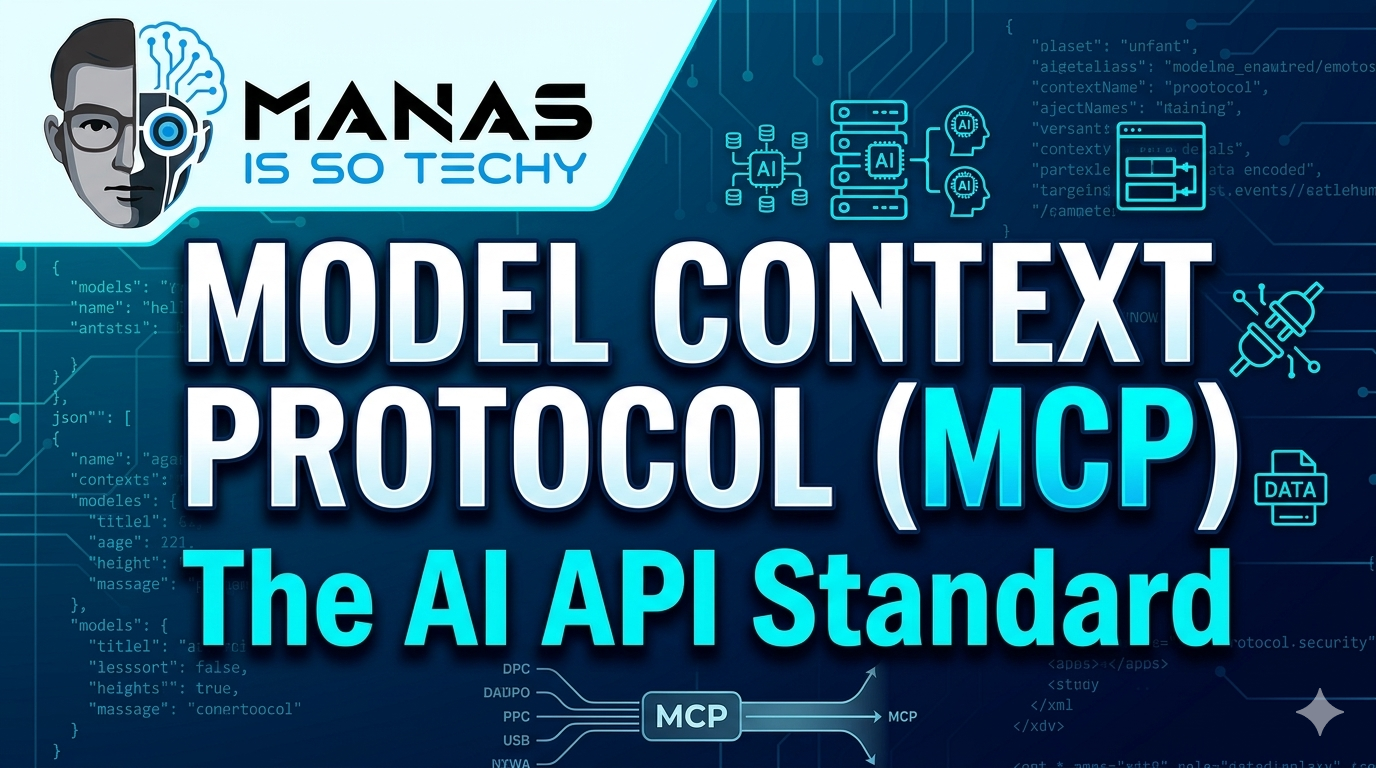
That's exactly why the Model Context Protocol (MCP) has emerged as one of the most important developer trends heading into 2026.
MCP creates a standardized way for AI models to communicate with tools, databases, APIs, files, and services. Think of it as USB-C for AI applications.
Instead of building custom integrations for every AI platform, developers can create MCP-compatible services once and connect them to multiple AI systems.
What Is Model Context Protocol (MCP)?
Model Context Protocol is an open standard that allows AI models to interact with external resources through a unified interface.
Traditionally, AI applications relied on custom function calling implementations.
The architecture usually looked like this:
AI Model → Custom Logic → API → Response
Every service required unique implementation code.
MCP changes the pattern:
AI Model → MCP Client → MCP Server → Resource
This abstraction layer allows developers to expose tools, databases, APIs, file systems, and business logic through a standardized protocol.
As a result, AI systems become more portable, scalable, and maintainable.
Why MCP Matters for Modern Development
Reduced Integration Complexity
Every developer eventually encounters integration fatigue.
One AI application might connect to ten different systems. Each system has its own SDK, authentication method, rate limits, and response format.
MCP creates a common interface.
Instead of teaching every AI model how to communicate with every service, services simply expose MCP endpoints.
The AI client already understands how to use them.
Better AI Agent Architecture
AI agents are evolving beyond chatbots.
Modern agents perform actions.
They create tickets, deploy code, update databases, analyze logs, review pull requests, and automate workflows.
Without a standard protocol, these capabilities quickly become difficult to manage.
MCP provides predictable communication between agents and tools, making large-scale agent systems far easier to maintain.
Enterprise Adoption
Large organizations are rapidly adopting AI internally.
Security teams want strict control over what AI systems can access.
MCP servers provide a centralized gateway where permissions, auditing, and governance can be enforced.
This makes MCP especially attractive for enterprise AI deployments.
How MCP Architecture Works
MCP Client
The client is typically the AI application itself.
Examples include:
AI coding assistants
Enterprise copilots
Internal company chatbots
Autonomous AI agents
The client sends requests to MCP servers whenever external information or actions are needed.
MCP Server
The server acts as a bridge between AI models and external resources.
It exposes capabilities in a structured format.
Examples include:
Database access
File system operations
Git repositories
Cloud infrastructure
Internal APIs
SaaS platforms
Resources and Tools
Resources provide data.
Tools perform actions.
For example:
A PostgreSQL MCP server may expose:
Resource:
Customer records
Tools:
Create customer
Update customer
Generate report
The AI model can discover and use these capabilities dynamically.
Building a Simple MCP Server
Let's look at a simplified Node.js example.
import { Server } from "@modelcontextprotocol/sdk/server/index.js"; const server = new Server( { name: "weather-server", version: "1.0.0" }, { capabilities: { tools: {} } } ); server.setRequestHandler("tools/list", async () => { return { tools: [ { name: "get_weather", description: "Get current weather information", inputSchema: { type: "object", properties: { city: { type: "string" } } } } ] }; }); server.setRequestHandler("tools/call", async (request) => { if (request.params.name === "get_weather") { return { content: [ { type: "text", text: "Temperature: 28°C" } ] }; } });
While simplified, this example demonstrates the core concept.
The AI discovers available tools and invokes them through a standard interface.
The same pattern can be applied to databases, CRMs, cloud services, or custom business applications.
Real-World Use Cases
AI Coding Assistants
Developer tools are among the biggest adopters of MCP.
Imagine an AI coding assistant that can:
Read repositories
Review pull requests
Query issue trackers
Access documentation
Deploy applications
Instead of custom integrations for each platform, MCP servers expose all these capabilities through one protocol.
DevOps Automation
Infrastructure teams can expose cloud operations through MCP.
An AI assistant could:
Check Kubernetes cluster health
Review logs
Scale services
Restart deployments
Generate incident reports
This creates a powerful bridge between AI and operations workflows.
Business Intelligence
Companies often struggle with fragmented data.
MCP allows AI agents to query multiple systems without developers writing separate connectors for every application.
The result is a more intelligent analytics environment.
Pros and Cons
Advantages
Standardized Integration
Developers build once and reuse across multiple AI platforms.
Faster Development
Teams spend less time writing integration code.
Better Scalability
Adding new tools becomes easier as systems grow.
Stronger Security Controls
Organizations can centralize permissions and monitoring.
Future-Proof Architecture
Applications become less dependent on specific AI vendors.
Disadvantages
Early Ecosystem
The MCP ecosystem is still growing and evolving.
Learning Curve
Teams need to understand protocol design and implementation patterns.
Additional Infrastructure
Running MCP servers introduces another architectural component.
Vendor Variations
Some platforms implement protocol features differently, requiring testing.
Why This Trend Will Explode in 2026
The AI industry is moving toward agent-based systems.
Developers no longer want isolated AI models that only generate responses.
They want AI systems that can interact with real-world tools and perform useful work.
The challenge is interoperability.
Just as REST APIs standardized web services and GraphQL simplified data access, MCP is positioned to become the standard layer connecting AI models with external systems.
Major AI platforms, enterprise software vendors, cloud providers, and developer tool companies are already embracing MCP-compatible architectures.
For developers building AI products today, learning MCP could become as important as understanding REST APIs was a decade ago.
The teams that adopt these patterns early will be better positioned to build scalable, tool-aware AI applications that can evolve alongside the rapidly changing AI ecosystem.