
🔥 Introduction
The definition of a “tech stack” is changing faster than ever.
In 2026–2027, it’s no longer just about frontend + backend + database.
It’s about AI integration, edge performance, automation, and scalability by design.
If you’re building a startup, SaaS product, or personal brand in tech — understanding the future stack is your biggest advantage.
Let’s break down the real future tech stack (2026–2027) 👇
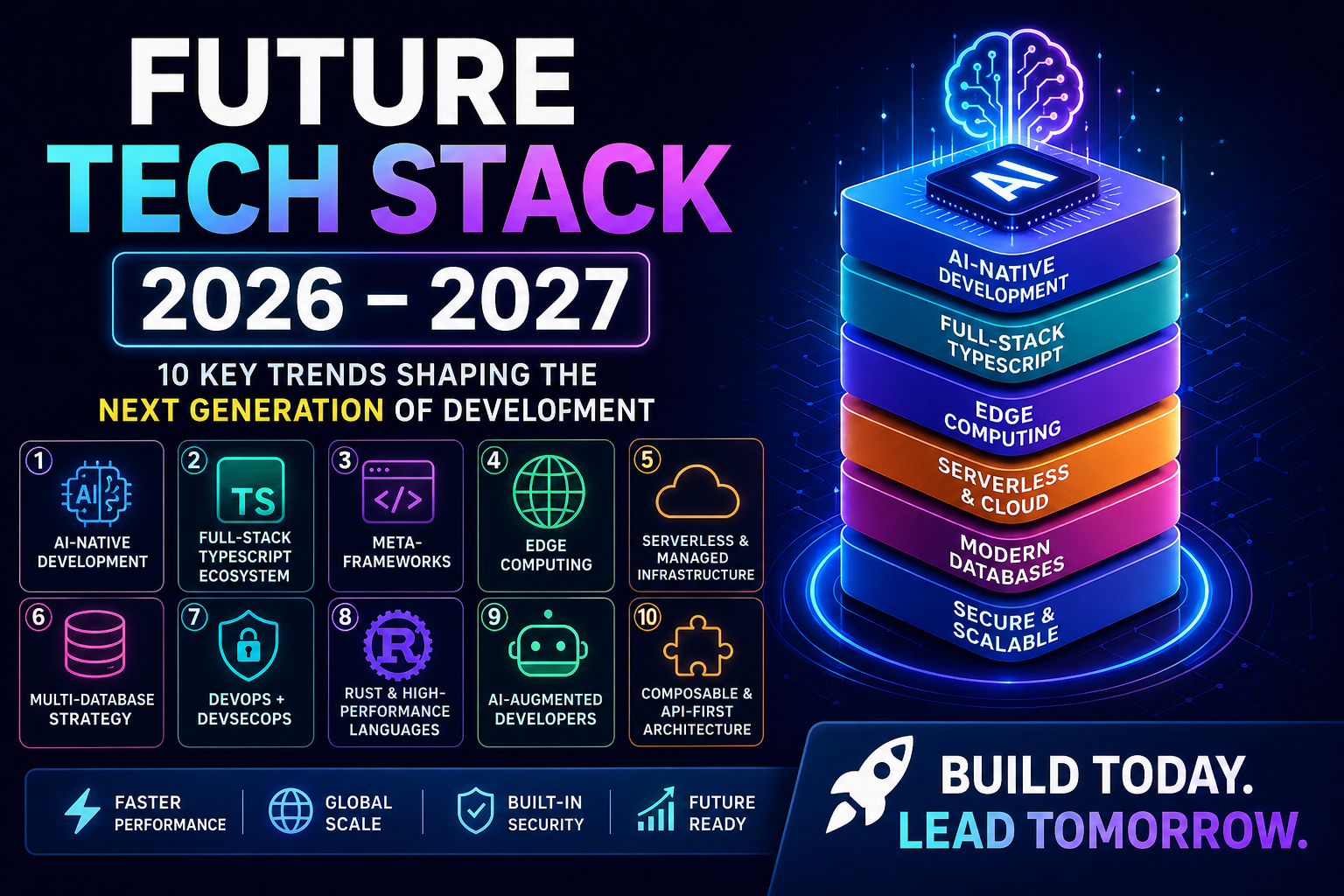
🧠 1. AI-Native Development (The Core Layer)
The biggest shift:
👉 AI is no longer a feature — it’s part of the infrastructure.
Modern stacks now include:
- LLM APIs (OpenAI, Gemini, etc.)
- Vector databases (for memory & search)
- AI agents (automation + workflows)
📌 Example use cases:
- AI chatbots in apps
- Personalized recommendations
- Automated coding & testing
➡️ By 2026, AI is becoming a default layer in software architecture
⚡ 2. Full-Stack TypeScript Ecosystem
The dominant stack in 2026–2027:
Frontend:
- React + Next.js
- Vue + Nuxt
- SvelteKit
Backend:
- Node.js / Bun / Deno
Why this stack wins:
- One language (JavaScript/TypeScript)
- Faster development
- Better collaboration
- Strong ecosystem
📌 TypeScript is now industry standard for scalability and safety
🌐 3. Meta-Frameworks (The New Standard)
Traditional frontend/backend separation is fading.
Modern development uses:
- Next.js
- Nuxt
- SvelteKit
These frameworks:
- Combine frontend + backend
- Provide SSR/SSG out of the box
- Optimize performance automatically
➡️ This reduces complexity and speeds up development massively
⚡ 4. Edge Computing (Speed is Everything)
Apps are moving closer to users.
Popular edge stack:
- Cloudflare Workers
- Vercel Edge Functions
- AWS Lambda@Edge
Benefits:
- Ultra-low latency
- Better global performance
- Real-time experiences
➡️ Edge computing is becoming mainstream for modern apps
🧱 5. Serverless & Managed Infrastructure
Developers don’t want to manage servers anymore.
Future stack includes:
- Serverless functions
- Backend-as-a-Service (BaaS)
- Managed Kubernetes
Tools:
- AWS, Google Cloud
- Firebase, Supabase
- Vercel
Why it matters:
- Faster deployment
- Lower cost
- Auto-scaling
➡️ Infrastructure is becoming invisible and automated
🧬 6. Database Evolution (Multi-Database Systems)
Old mindset:
👉 “Use one database for everything” ❌
New mindset:
👉 “Use the right database for each task” ✅
Modern stack:
- PostgreSQL (core data)
- MongoDB (flexible data)
- Vector DB (AI memory)
- Redis (caching)
➡️ This is called Database Pluralism
⚙️ 7. DevOps + DevSecOps (Built-In Security)
Security is no longer optional.
Future stack includes:
- CI/CD pipelines
- Automated testing
- Security scanning
- Infrastructure as Code
Tools:
- Docker
- Kubernetes
- GitHub Actions
- Terraform
➡️ Security is now embedded into development pipelines
🦀 8. Rust & High-Performance Languages
JavaScript is not enough for everything.
Rising languages:
- Rust (performance + safety)
- Go (backend systems)
- Python (AI/ML)
📌 Rust is rapidly growing for:
- Developer tools
- High-performance systems
➡️ Because it offers speed + memory safety
🤖 9. AI-Augmented Developers
Developers are no longer coding alone.
New workflow:
- AI writes code
- Dev reviews + improves
- AI tests & debugs
Tools:
- GitHub Copilot
- AI IDEs
- Autonomous agents
➡️ AI-assisted development is becoming standard practice
🌍 10. Composable & API-First Architecture
Future systems are modular.
Instead of building everything:
👉 You connect services via APIs
Examples:
- Headless CMS
- Microservices
- Third-party APIs
Benefits:
- Faster scaling
- Flexible architecture
- Easy integration
➡️ API-first design dominates modern systems
🧾 Example: Future-Proof Tech Stack (2026–2027)
Here’s a practical stack you can use:
🔹 Frontend:
- Next.js + TypeScript + Tailwind
🔹 Backend:
- Node.js / Bun + API routes
🔹 Database:
- PostgreSQL + Vector DB
🔹 AI Layer:
- OpenAI / Gemini APIs
🔹 Infrastructure:
- Vercel / AWS (Serverless)
🔹 DevOps:
- Docker + GitHub Actions
⚠️ Key Reality Check
There is no single “best” tech stack.
Your stack depends on:
- Your product
- Your team
- Your budget
- Your goals
➡️ In 2026, success depends on how well your stack adapts, not which tools you choose
🧠 Final Thoughts
The future tech stack is:
✅ AI-first
✅ Cloud-native
✅ Edge-powered
✅ Type-safe
✅ Modular
If you understand this shift early,
you won’t just follow trends —
you’ll build products that dominate them.
🚀 Pro Tip (For You)
Since you're building:
- SaaS
- Media platform
- AI-driven products
👉 Focus on:
- Next.js + AI APIs + Supabase/Vercel
- Learn system design + AI integration
That combo alone can make you ahead of 90% developers in 2026.
If you want, I can also:
- Build your personal tech stack roadmap
- Or design a complete startup stack (based on your business ideas)
Create an Infographics based Thumbnail for this blog.
.jpeg)